Table of content

This concrete cost calculator lets you estimate how much concrete you need and how much it will cost. Enter your project dimensions and get instant results for volume and price without manual calculations.
Getting an estimate is quick and straightforward. Just follow these steps and you’ll have your concrete volume and cost in seconds:
Step 1: Enter the dimensions
Start by filling in the length and width of the area you plan to pour. Then add the thickness of the concrete. Make sure all values are in the same unit system.
Step 2: Choose your unit
Select whether you want to work in meters or feet. The calculator will automatically adjust the result into cubic meters (m³) or cubic yards (yd³).
Step 3: Input the price per unit
Enter the cost of concrete per cubic meter or cubic yard. You can get this number from your local supplier or use an average market rate.
Step 4: Click “Calculate”
Once all fields are filled, hit the calculate button. The tool will instantly process your inputs.
Step 5: View your results
You’ll see the total concrete volume required and the estimated cost based on your input price. Use this number to plan your budget or compare different pricing options.
👉 Tip: Add a small extra percentage (around 5–10%) to your result to account for waste or uneven surfaces.
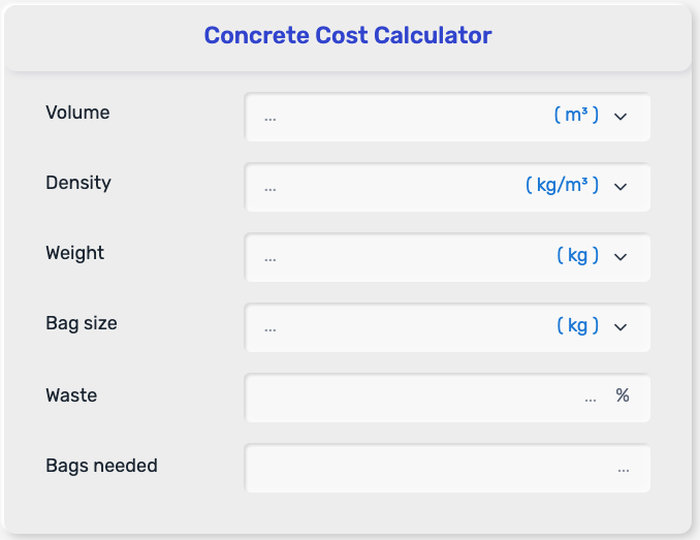
This tool is designed to give you quick, practical numbers without extra steps. Here’s what you can calculate:
Concrete volume for slabs, patios, driveways, walkways, and foundations
Total estimated cost based on your price per cubic meter or cubic yard
Material quantity needed before placing an order
Optional conversion between different unit systems
Estimated number of concrete bags (for smaller projects, if applicable)
Whether you're working on a small backyard project or planning a larger construction job, this concrete price calculator gives you a clear starting point for both volume and cost.
After entering your values, the result shows two key outputs: total concrete volume and estimated cost.
The volume tells you how much concrete is required to fill the space you measured. This is usually displayed in cubic meters (m³) or cubic yards (yd³), depending on your selection. It’s the number you’ll use when ordering from a supplier.
The cost is calculated by multiplying that volume with the unit price you entered. This gives you a rough budget for materials, making it easier to plan ahead or compare different suppliers.
Here’s how you can use these results in real situations:
Ordering materials: Use the volume to request quotes or place orders
Budget planning: Get a quick idea of how much your project might cost
Comparing prices: Try different price inputs to see how supplier rates affect your total
Avoiding shortages: Adjust the result slightly upward to cover waste or uneven surfaces
👉 Keep in mind: the result is an estimate. Final costs may vary depending on delivery fees, labor, and site conditions.
A concrete cost estimator is useful for many everyday building and renovation jobs. It gives you a fast way to check material needs before you buy, budget, or request quotes.
Here are some of the most common projects where this tool is used:
Driveways for homes or small commercial spaces
Patios, garden pads, and outdoor seating areas
Sidewalks and walkways around a property
Garage floors and shed bases
Concrete slabs for workshops or storage areas
Footings and small foundation sections
Repair jobs that require a fresh concrete pour
For small jobs, a concrete price calculator can also help you decide whether bagged concrete is enough or if ready-mix is the better option. For larger pours, it gives you a clearer number to discuss with suppliers and contractors.
This is especially useful when you want to avoid ordering too little concrete, which can delay the job, or too much, which can increase waste and cost. Even a basic estimate can make planning much easier before the work begins.

The total you get from a concrete cost calculator is a solid starting point, but the final price can shift depending on several real-world details. Even when two projects have the same area, the total cost may still be different because concrete pricing is influenced by more than just square footage.
Some areas also have fewer suppliers, which can limit pricing options. For that reason, it is smart to compare quotes from more than one company before placing an order.
When using a concrete cost estimator, it is worth treating the first result as your base number, then adjusting slightly if the site conditions are less predictable.
If you want a quick visual walkthrough, this video on how to estimate a concrete order shows the full process step by step.
Getting the right amount of concrete is just as important as calculating the cost. Ordering too little can delay your project, while ordering too much increases your total expense.
Start by measuring your area carefully. Check length, width, and depth in multiple spots, especially if the ground is uneven. Even small differences can change the total volume more than expected.
Once you have your base volume from the concrete cost calculator, treat it as a starting point. Real projects often need a bit more to account for small gaps, formwork edges, or uneven surfaces.
It is also worth checking how your supplier handles orders. Some companies set minimum quantities or charge extra for smaller loads. If your project is close to that limit, adjusting your order slightly can sometimes reduce additional fees.
A small buffer is usually a smart move. Many people add around 5% to 10% to avoid running short in the middle of the pour. This is often cheaper than stopping and placing a second order.
Taking a few extra minutes to plan your order can save both time and money once the work begins.
Concrete Network. Concrete Calculator – How Much Do I Need? (Bags & Yards)
https://www.concretenetwork.com/concrete/howmuch/calculator.htm
National Ready Mixed Concrete Association (NRMCA). CIP 31 - Ordering Ready Mixed Concrete
https://www.nrmca.org/wp-content/uploads/2021/01/31pr.pdf
Concrete Network. How Much Concrete Do I Need for a Driveway?
https://www.concretenetwork.com/concrete/howmuch/for-a-driveway.html
Concrete Network. How Much Concrete Do I Need for a Patio?
https://www.concretenetwork.com/concrete/howmuch/for-a-patio.html
Concrete Network. How Many Square Feet Will a Yard of Concrete Cover?
https://www.concretenetwork.com/concrete/howmuch/square-feet-in-a-yard.html
National Ready Mixed Concrete Association (NRMCA) / ASCC. Checklist for Ordering and Scheduling Ready Mixed Concrete
https://www.nrmca.org/wp-content/uploads/2021/06/2Ordering-Scheduling.pdf
Concrete Network. 12 DIY Concrete Slab Mistakes to Avoid When Pouring
https://www.concretenetwork.com/concrete/slabs/diy-mistakes.html
Yes. A concrete cost estimator is commonly used for driveways, patios, walkways, garage floors, and shed slabs. You just need the correct length, width, thickness, and local price per cubic yard or cubic meter.
Yes, in many cases adding a small buffer is a smart idea. Many people add around 5% to 10% extra to cover waste, uneven ground, spills, or small measuring errors.
Yes, for small projects you can use the volume result to estimate how many bags you may need. This is useful for short walkways, small pads, fence post bases, and repair jobs.
Thickness changes the total volume of concrete required. Even a small increase in slab depth can add a noticeable amount of material, especially on a large surface. That is why the final estimate can rise quickly.
For larger pours, ready-mix is often the better value and much more practical. For small jobs, bagged concrete may be easier to buy and manage. The better option usually depends on total volume, local pricing, and delivery availability.
Concrete-cost-calculator.com is built to help homeowners, contractors, and builders quickly estimate the cost of concrete for slabs, foundations, driveways, patios, and other construction projects. By combining practical calculations with a simple user-friendly design, this tool makes project planning easier, faster, and more accurate.
This tool was created by the concrete-cost-calculator.com team, with contributions from developers and content specialists dedicated to building reliable, easy-to-use calculation tools that support smarter construction planning and budgeting.
We are committed to providing clear, practical, and easy-to-use calculation tools while respecting user privacy and promoting transparency.
Concrete-cost-calculator.com does not require registration or collect personally identifiable information. The values entered into the calculator are used only to generate cost estimates and are not stored or shared.
This tool provides estimated concrete costs based on the information you enter and general calculation methods. Actual project costs may vary depending on local material prices, labor rates, site conditions, waste factors, and contractor fees. For exact pricing, please consult a qualified supplier or construction professional.
By using this tool, you understand that the results are intended for informational and planning purposes only. We are not responsible for decisions made solely on the basis of these estimates.
We may revise this Policy from time to time to reflect updates to the tool, improvements in functionality, or changes in applicable standards. Any updates will be published on this page.